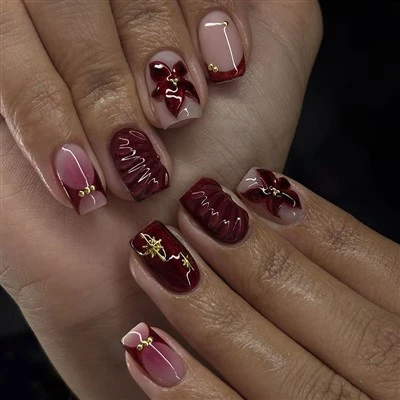

As the nail beauty industry continues to move toward greater personalization and refined craftsmanship, 3D press-on nails are gaining attention due to their unique three-dimensional structures, enhanced visual effects, and strong design expression. Compared with traditional flat press-on nails, 3D designs integrate patterns, decorative elements, and spatial layers into the nail structure, creating a more realistic and artistic beauty experience. Industry professionals believe that structural design is a key factor influencing the appearance, comfort, and overall quality of 3D press-on nails.
The most distinctive feature of 3D press-on nails is their three-dimensional design approach. Traditional nail products mainly rely on colors, patterns, and surface finishes for decoration, while 3D press-on nails create richer visual effects by adding depth and layered structures. Designers use techniques such as embossed patterns, raised floral decorations, metallic elements, pearl details, and multi-layer compositions to create highly expressive nail designs that resemble miniature works of art.
In terms of nail structure, 3D press-on nails are usually developed with ergonomic curved designs. By analyzing natural nail shapes, manufacturers optimize the curvature, length, and edge structure of nail tips to achieve a better fit for different users. A well-designed curved structure improves natural appearance after application and enhances wearing comfort by reducing pressure and discomfort.
Multi-layer construction is another important characteristic of 3D press-on nails. By combining base nail layers, decorative components, and protective coatings, manufacturers can achieve more complex design effects. Features such as raised flowers, gradient textures, and transparent visual effects often require advanced multi-layer processing techniques. The coordination between different layers enhances visual depth while improving product stability.
Material selection also plays an important role in the structural performance of 3D press-on nails. Modern manufacturing commonly uses flexible and durable polymer materials that maintain lightweight comfort while providing sufficient strength. For three-dimensional decorative elements, manufacturers select suitable materials based on design requirements and use precision processing techniques to ensure secure attachment without affecting wearing comfort.
During production, digital design and precision manufacturing technologies provide strong support for structural innovation. Through three-dimensional modeling, precision mold production, high-resolution printing, and automated manufacturing systems, companies can accurately create complex structures while improving product consistency and production efficiency.
Industry experts believe that future 3D press-on nails will continue developing toward lightweight construction, personalized designs, and intelligent manufacturing. With ongoing improvements in materials and production technologies, 3D press-on nails will achieve further breakthroughs in structural creativity, wearing comfort, and artistic expression, providing consumers with more diverse and high-quality nail beauty options.