
1. Materials Used in Press-On Nails
Material selection directly affects the flexibility, durability, appearance, and application experience of press-on nails.
ABS plastic is commonly used for traditional press-on nails because it provides a balance between strength, flexibility, and cost. Soft gel materials are also widely used for products that require a more flexible feel and closer adaptation to the natural nail.
Different materials can support different product positioning. For example, a rigid ABS nail may be suitable for standard wholesale collections, while soft gel tips can be used for products requiring greater flexibility or a more natural appearance.
For B2B buyers, material specifications should be confirmed during product development rather than judged only from photographs.
2. Nail Shape, Size and Length
Press-on nails are available in multiple shapes and lengths, including almond, coffin, square, oval, round, and stiletto.
Size selection is particularly important because nail beds vary significantly between users. Standard size sets normally contain multiple nail sizes so consumers can select the closest fit for each finger.
For private-label projects, manufacturers can also develop specific size combinations or customized molds according to the target market. This allows brands to create collections for different customer groups rather than relying entirely on standard nail dimensions.
3. Surface Finishes and Nail Art
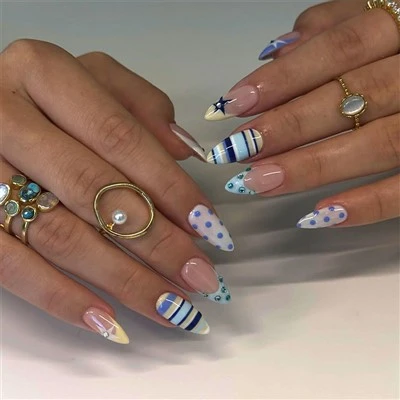
Modern press-on nails can include a wide range of surface treatments and decorative techniques. Common options include glossy, matte, chrome, cat-eye, French tips, pearl effects, metallic finishes, gradients, and translucent effects.
Additional decoration can include rhinestones, pearls, charms, glitter, foil, 3D flowers, bows, and other decorative elements.
For wholesale collections, the choice of decoration should consider both visual appeal and production consistency. Three-dimensional elements, for example, may require additional assembly and quality inspection compared with printed designs.
4. Manufacturing Process
A typical press-on nail production process involves several stages:
Mold Development → Material Forming → Nail Shape Processing → Surface Treatment → Printing or Decoration → Assembly → Quality Inspection → Packaging
Each stage can affect the final product.
Mold accuracy influences nail shape and consistency. Surface preparation affects the adhesion of coatings and printed designs. Decoration requires inspection to ensure that components are positioned correctly and securely.
For customized orders, sample development normally takes place before mass production. Buyers can review the sample, confirm dimensions, colors, artwork, decoration, and packaging before approving production.
5. Quality Control for Wholesale Orders
Quality control is an important consideration for wholesalers and private-label brands because inconsistent products can affect customer reviews and retail returns.
Manufacturers may inspect several aspects of finished press-on nails, including:
Nail shape and dimensional consistency
Surface smoothness
Color consistency
Printing accuracy
Decoration placement
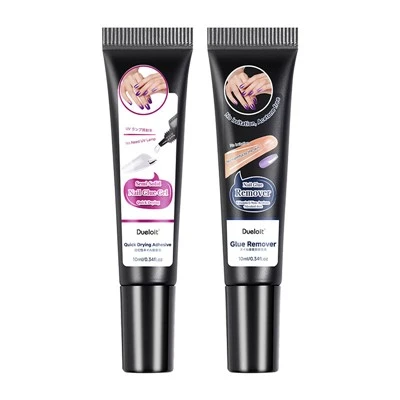
Adhesive accessories
Packaging assembly
Quantity and product completeness
For large orders, inspection procedures should be agreed upon before production. Buyers can also request product samples or pre-production samples to establish the approved quality standard.
6. Press-On Nails and Private Label
Private-label press-on nails allow brands to sell products under their own brand identity while working with an experienced manufacturer.
Customization can cover the nail design itself as well as the complete retail presentation. Typical options include:
Nail shape and size
Length
Colors and finishes
Printed patterns
3D decorations
Brand logo
Nail cards
Product boxes
Instruction cards
Accessories
Barcode and labeling
Packaging is especially important for retail products because it protects the nails while providing space for branding, product information, instructions, and compliance-related information required for the target market.
7. OEM vs. ODM Press-On Nails
OEM and ODM services are commonly used in the press-on nail industry, but they represent different development approaches.
OEM generally means the buyer provides the product specifications, artwork, design, or other requirements, while the manufacturer handles production according to those specifications.
ODM usually involves the manufacturer providing existing designs, manufacturing expertise, or product-development support that can then be adapted for the buyer's brand.
A business launching a completely new collection may use ODM support to shorten product-development work, while an established brand with its own designs may prefer OEM production.
8. Packaging and Retail Presentation
Press-on nail packaging can range from simple boxes to customized retail structures such as drawer boxes, gift boxes, flip-top boxes, and display-oriented packaging.
Packaging customization may include different materials, structural designs, logo applications, color systems, printing effects, and inserts.
For B2B buyers, packaging should be considered together with shipping requirements. A visually attractive package also needs sufficient protection during transportation and storage.
9. What Buyers Should Confirm Before Ordering
Before placing a wholesale or private-label order, buyers should confirm the product specifications in writing.
Important points include:
Nail material and thickness
Shape, size and length
Surface finish and decoration
Nail design and artwork
Accessories included in each kit
Packaging structure and materials
Logo and labeling requirements
MOQ and pricing tiers
Sample approval process
Production and delivery schedule
Clear specifications reduce misunderstandings between buyers and manufacturers and make quality inspection easier during mass production.
Conclusion
The press-on nail industry combines beauty design with material selection, manufacturing technology, quality control, packaging, and private-label development. For wholesalers, distributors, and beauty brands, understanding these factors makes it easier to evaluate suppliers and develop products that match their target market.
For manufacturers, the ability to support customized nail shapes, designs, decorations, packaging, and OEM/ODM production provides more flexibility for different B2B projects. As the market continues to expand, product consistency, customization capability, and clear manufacturing communication remain important parts of successful press-on nail development.