

1. Check the Manufacturer's Product Capability
Before discussing pricing, buyers should confirm whether the supplier can manufacture the nail styles and specifications required for their target market.
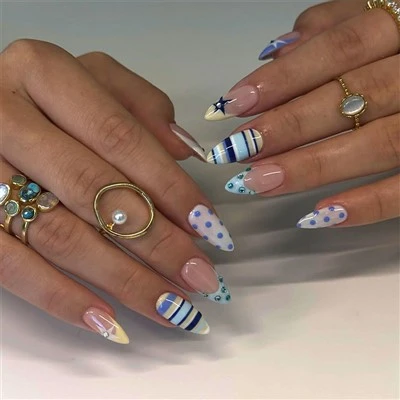
Important factors include nail shapes, lengths, sizes, surface finishes, colors, decorative elements, and application methods. A supplier with a broader production range can usually support more product variations within the same supply chain.
For wholesale buyers, it is also useful to confirm whether the manufacturer can handle both standard designs and customized products. This becomes particularly important when a brand plans to expand its collection after the initial launch.
2. Evaluate Material and Product Consistency
Material selection directly affects the flexibility, appearance, durability, and application experience of press on nails.
Buyers should ask about the material used for the nail tips and whether material specifications remain consistent between sample production and bulk manufacturing. Samples should not be treated as a separate product from the eventual production order.
For international distribution, buyers may also need documentation related to product safety and material compliance, depending on the destination market. Documents such as MSDS, REACH, or RoHS may be requested during supplier qualification.
3. Look Beyond the Sample
A good sample does not automatically guarantee consistent bulk production.
During supplier evaluation, buyers should consider how the factory manages production quality. Useful checkpoints include nail shape consistency, size accuracy, color matching, surface finish, decoration placement, packaging condition, and final inspection procedures.
For customized collections, an approved sample should be used as a production reference. This helps reduce differences between the approved design and the final shipment.
4. Understand OEM and ODM Services
OEM and ODM are two common cooperation models for private label nail brands.
With OEM, the buyer normally provides the product concept, artwork, specifications, or existing design requirements, while the manufacturer produces the products according to the agreed specifications.
With ODM, the manufacturer may provide existing designs, technical development, product combinations, or customization options that the buyer can adapt to its own brand.
Before placing an order, buyers should clarify which parts can be customized, including nail shape, length, color, finish, artwork, decorations, logo, packaging, accessories, and product inserts.
5. Consider Packaging as Part of the Product
For private label press on nails, packaging is not simply an outer container. It can involve structural design, printed graphics, brand identification, product information, and accessory organization.
Common packaging options may include paper boxes, drawer-style boxes, flip-top boxes, acrylic packaging, inner trays, instruction cards, and application accessories.
Buyers should confirm whether the supplier can coordinate nail production and packaging production. Working with one manufacturing partner can simplify communication and reduce coordination between different suppliers.
6. Compare MOQ and Production Lead Time
Minimum order quantity varies between suppliers and product types.
Standard designs may have different MOQ requirements from fully customized products because customized colors, molds, decorations, packaging, and printed materials can require additional production preparation.
Lead time should also be separated into sampling time and bulk production time. A practical purchasing discussion should clarify:
Sample development time
Sample approval process
Bulk production lead time
Packaging production time
Inspection time
Shipping preparation
For repeat orders, production may be more efficient because product specifications and packaging files have already been established.
7. Check Production Capacity
Production capacity matters when a brand moves from testing to larger-scale sales.
A supplier may be able to produce small trial orders but struggle when monthly purchasing volume increases. Buyers should therefore consider whether the factory has sufficient production equipment, workers, quality-control procedures, and packaging capacity to support future orders.
For example, a manufacturer with a stated press-on nail production capacity of hundreds of thousands of pieces per day may be better positioned to handle larger wholesale programs than a small workshop with limited production resources.
However, capacity should always be evaluated together with quality consistency and actual delivery performance.
8. Ask About Quality Inspection
Quality control should cover more than checking the finished appearance.
For press on nails, inspection can include product dimensions, shape, color, surface condition, decorative details, quantity, packaging, and accessories.
A clear inspection procedure can help identify defective products before shipment. Buyers should ask whether the supplier conducts inspection during production, after production, or before final packing.
It is also useful to establish acceptable quality standards before bulk production begins. This gives both the buyer and manufacturer a clear reference when handling quality issues.
9. Review Communication and Customization Process
Communication becomes especially important for OEM and private label projects.
A typical customization workflow may include:
Consultation → Product Specification → Design Confirmation → Sampling → Sample Approval → Bulk Production → Quality Inspection → Packaging → Delivery
Each stage should have clear confirmation points. Product artwork, dimensions, colors, packaging files, quantities, and shipping requirements should be confirmed before production begins.
This structured process can reduce misunderstandings and unnecessary production changes.
10. Choose a Supplier for Long-Term Cooperation
The lowest unit price is not always the lowest total purchasing cost.
Repeated sampling, production delays, inconsistent products, packaging mistakes, and communication problems can create additional expenses for a brand.
A reliable press on nails supplier should therefore be evaluated through a combination of product quality, customization capability, MOQ, production capacity, lead time, packaging support, documentation, communication, and after-sales handling.
For brands building a long-term nail product line, supplier selection should focus on whether the manufacturer can support the business as its product range and order volume grow.
Final Considerations
Selecting a press on nails supplier requires more than comparing quotations. Buyers should examine the complete manufacturing process, from material selection and product development to quality inspection, packaging, and delivery.
For wholesale and private label businesses, a manufacturer that can coordinate product customization, OEM/ODM production, private label packaging, quality control, and bulk manufacturing can provide a more efficient supply-chain solution.
Before confirming a long-term partnership, buyers should request samples, verify production capabilities, clarify customization specifications, review compliance documents where required, and establish clear quality standards for bulk orders.